



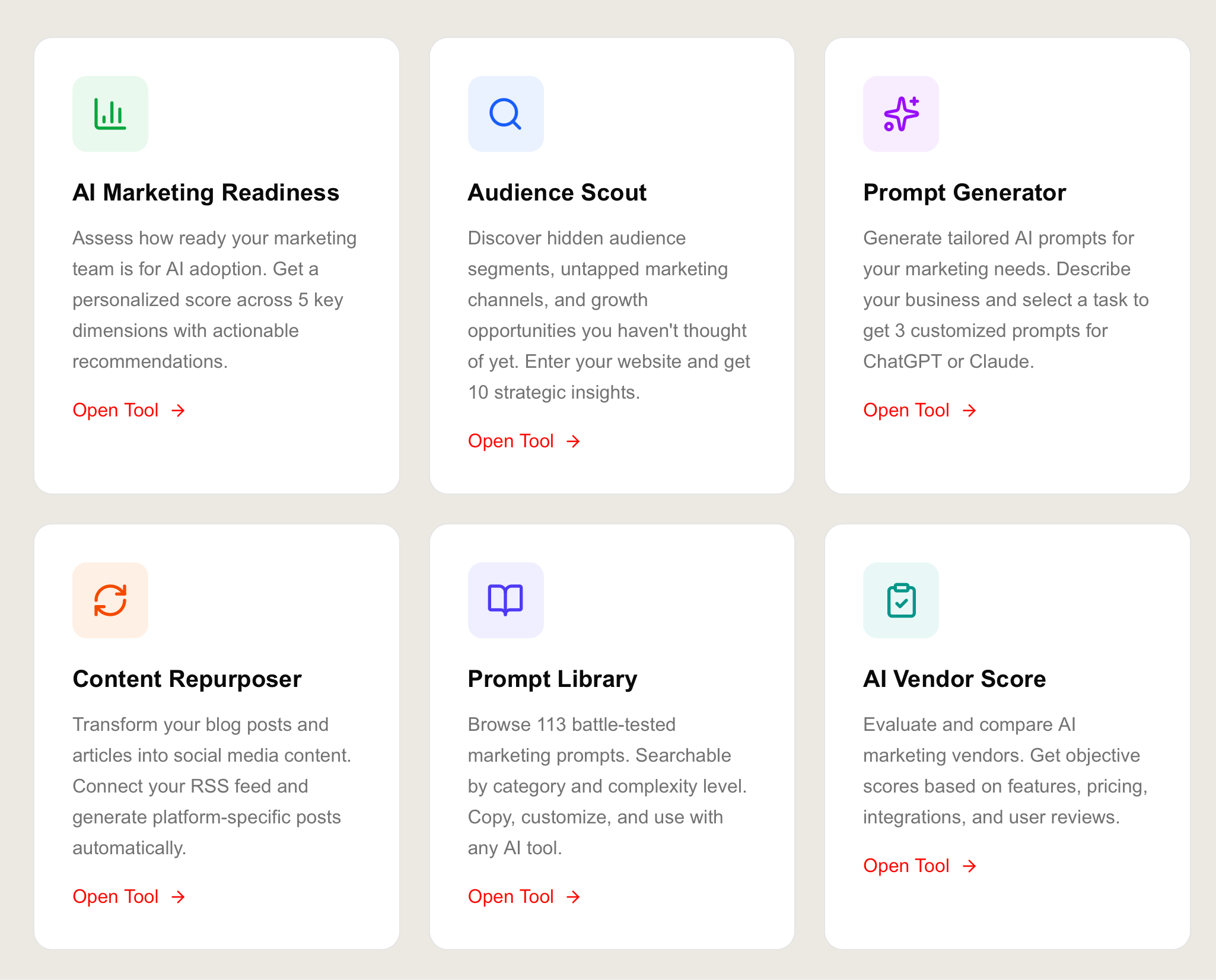
This week, we announced the addition of 6 new AI marketing tools to our paid offering. We fully believe that this year's greatest trend will be personal software. This edition explains what it means, why we believe in it, and how to address it as a marketer.
What is personal software?
Personal software is a tool fully customized to your needs. It does what you want, and only what you want. No extra features, no extra steps, just the workflow you want and the goals you want to achieve.
If you gave it to someone else, they might not use it as well as you do - because their workflow is slightly different. This is especially true in creative workflows, which we all do as marketers.
This is fundamentally different from classic SaaS. Most digital tools are bloated with features you don’t need, and you need multiple tools to accomplish one workflow. A startup uses Zapier, Kit, Pipedrive, HubSpot, and Leadpages just to service one email funnel. Most Salesforce features sit unused.
You adapt your workflows to your tools. With personal software, the tool adapts to YOUR workflows.
The glorified PM
This adaptation created problems, especially in marketing leadership. We sit on demos, source vendors, and create marketing budgets with line items. We have an almost kinky way of saying: “our marketing stack.”
That’s a problem. We’re not leading. We’re not figuring out the big picture. We’re not focusing on strategy. We’re glorified project managers.
In an era of measured performance, intuition and taste are hard to justify to the C-suite. Yet creativity IS defined by these things, not by “spike in engagement numbers in our quarterly analytics report.”
We became technologists, which is why we became project managers. We struggle to focus on what matters: strategy, brand, creative outcomes.
Our work became a technological project to manage, yet we didn’t become engineers. Most of us don’t code, and most of us are allergic to hardcore tech terms.
Good news: we don’t need to become engineers. Most AI-powered engineers haven’t written a single line of code in months. They manage and oversee AI to do that.
Now, as marketers, we can build our own tools. Our own personal software for our own needs.
Why build now?
Because once you stop adapting your needs to tools, you win time. Time and mental bandwidth. You stop managing plugins, attending demos, and clarifying pricing tiers.
The old model: Had an idea → Briefed team → Waited → Rebrief because the tool doesn’t work that way → Refine → Start over
New model: Had an idea → Test in 30 minutes → Build tool → Start over
You can turn ideas into tools in under an hour.
The time between hypothesis and evidence is zero. You can be wrong 100x more. Why? Being wrong is cheap. Being wrong is instant. Pattern recognition accelerates, feedback loops tighten.
Our example
We built the Social Repurposer tool in 4 hours. Zero lines of code. All Claude Code.
We started with a problem: spending too much time repurposing newsletter content to social, even with AI. Chat interfaces are bad for copy-pasting. AI didn’t learn our voice well enough. Hard to scale to multiple platforms.
So we built a tool that:
Auto-checks your RSS for new content
Generates 1x or 3x options per channel
Handles multiple channels at once
Lets you add brand voice training materials
Learns from your edits
Unlocks FULL AUTO mode at level 5 (you get emails with ready copy)
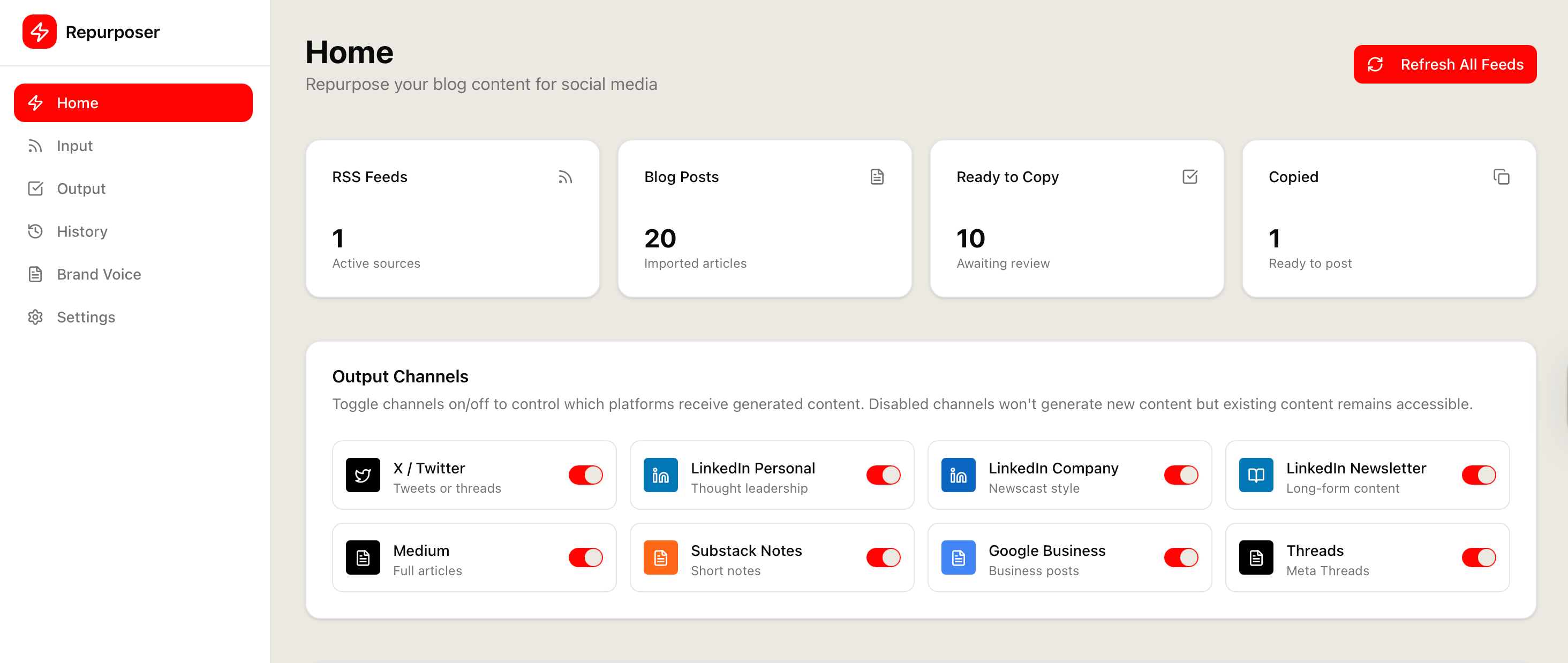
However, this isn’t the tool WE use. We use the 2.0 version.
The 2.0 has 80% fewer features. It’s minimalistic. Almost horrible to look at. Why? Because it has only the features WE need. Nothing more.
Two learnings here:
Anything is doable at will. You can build personal software with intent, ideas, and agency.
The best software isn’t the one with the most features. It’s the one with only the features YOU need.
With this tool, we spend 30 minutes daily generating social content for multiple platforms. The question “Should we hire a social media manager?” went into the sink.
Now, how do you do it?
It’s time to build
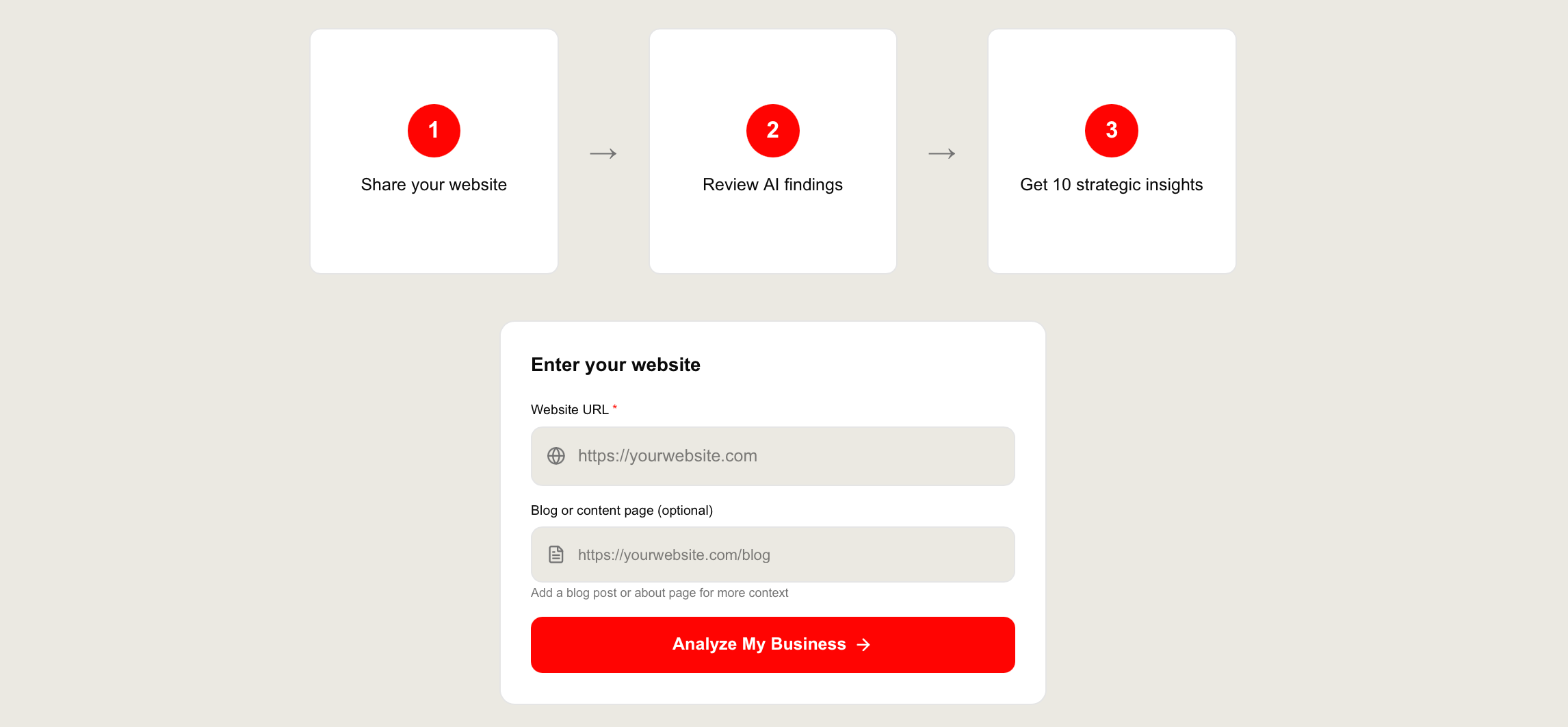
We are going to explain the principles of this using one of our simplest tools, the Scout.
It does this:
You put your website URL in (5 seconds)
AI presents guesses on 6 categories with confidence levels. You edit or confirm (1 minute)
You get an audience insights report with hidden segments, untapped channels, messaging gaps, campaign angles, and partnership opportunities. Download as TXT.
No more hours explaining your business to ChatGPT. Done in 5 minutes. Built in 30 minutes from scratch.
Setting up the foundations
Think of it as building a workshop before furniture. You need 3 components: the toolkit, the building, and the shelves.