Your New Audience Has No Eyes
This week in AI & marketing


Somewhere in your analytics right now, there is a visitor session that looks slightly wrong. It loaded twelve pages in forty seconds. It read your pricing page, your return policy, and your documentation, in that order, at three in the morning. It didn’t bounce, didn’t convert, didn’t join your list. Then it left and told someone what it found.
That visitor was an AI agent working on behalf of a customer, and there are more of them every week. Cloudflare says over half of web traffic is now non-human. One study found that in three-quarters of Google AI Mode sessions, no human ever clicks through to a website at all. The person still exists. They still have budget and intent. They just sent a machine ahead to do the reading.
This is a strange moment to be a marketer, because everything we build is designed for eyes. Hero images, headline tests, page speed, brand color, the carefully sequenced nurture email. All of it assumes a human is looking. Meanwhile, the fastest-growing segment of your audience has no eyes, no patience for your interface, and no ability to be charmed. It either finds clear, structured, retrievable information, or it moves on and quotes your competitor instead.
Nobody is going to announce this transition. It shows up as slowly declining traffic that still somehow produces sales, as an agent fumbling through your checkout, as your content getting cited without a single click. The question used to be what your customer sees when they land on your site. The new question is what their machine gets. Most brands haven’t answered it, because most brands haven’t noticed they’re being read.
— Peter & Torsten
OpenAI Finally Ships the Super App
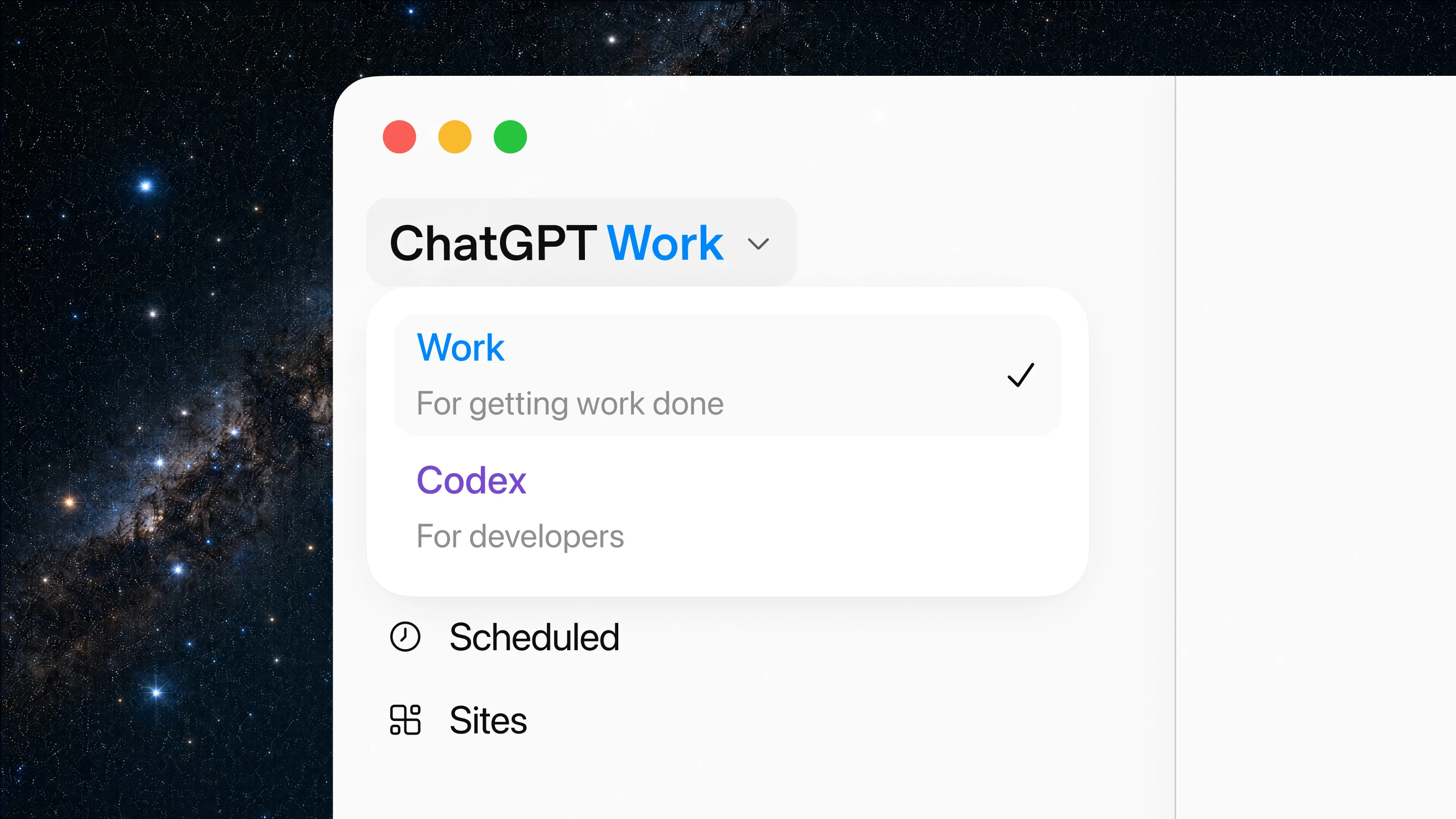
After months of teasing, OpenAI’s “super app” is here, and it looks a lot like Claude Cowork. ChatGPT Work merges the chatbot with Codex, OpenAI’s coding agent, into a single application that can dig through your connected apps, break a complex project into steps, and grind on it for hours: finished decks, docs, sheets, even hosted websites. It runs on GPT-5.6, which launched the same day, and it’s rolling out to Pro, Enterprise, and Edu users first, with Plus and Business following.
The magic, just as with Cowork, is that it can work through absolute mess. Not the clean, tagged version of your marketing folder that exists in your head, but the real one with half-finished briefs, three versions of the same deck, and a dozen of call transcripts nobody read.
ChatGPT Work is built to pull finished work out of that pile, and OpenAI claims its own finance team cut month-end close from days to hours doing exactly this.
On the flip side, the app is genuinely confusing at first (Chat, Work, Codex, Sites, and Scheduled Tasks now all live in one desktop app, and the Atlas browser is being sunset on top of it), and usage is metered like Codex, so complex tasks eat your plan faster than a chat ever did. Still, this is now the second major lab betting that the chat window is where work actually gets finished.
Kimi K3 Crashes the Frontier Party
Every few months, an open model drops and someone on LinkedIn declares the gap with the closed labs officially closed (this has been going on for at least a year now, and it is legitimately funny).
But this time the benchmarks mostly back them up.
Moonshot AI released Kimi K3 last week and it’s an amazing model on par with the very best from Anthropic and OpenAI. The number that matters for our corner of the world comes from AA-Briefcase, Artificial Analysis’s benchmark for long-horizon knowledge work: multi-week projects built from messy spreadsheets, emails, and transcripts, graded on deliverables like market analyses, segmentations, and presentations. Kimi K3 scored 1543, second only to the eye-wateringly expensive Claude Fable 5 (1574) and ahead of GPT-5.6 Sol, Claude Sonnet 5, and everything else you can currently buy. The previous Kimi generation scored 816 on the same scale. Yes, it’s an Elo-style score, but a +727 jump is absurd on any scale.
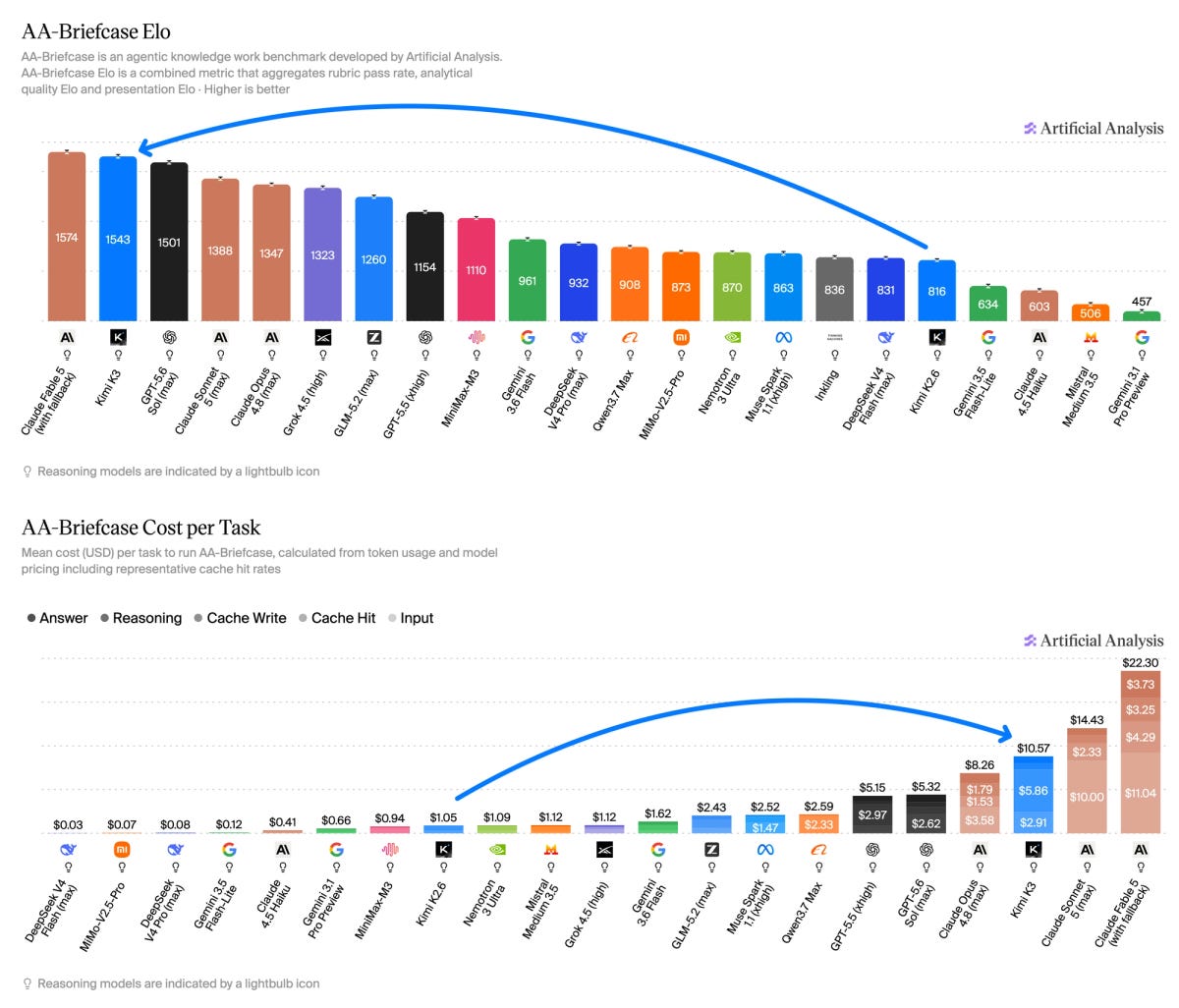
One carve-out before you rip out your Anthropic subscription: “open” doesn’t mean cheap or fast here. K3 averages $10.57 per Briefcase task and nearly an hour of runtime, which makes it pricier to run than Claude Opus 4.8 and roughly 2.5x slower than Fable 5. So no, you probably won’t switch. But when frontier-level knowledge work exists as downloadable weights, the closed labs lose pricing power, and you gain negotiating room. Your procurement team just needs to be able to credibly threaten to leave.
Google Zero Stops Being a Metaphor
Nilay Patel has been warning publishers about “Google Zero,” the day Google traffic drops to nothing, for years, mostly to eye-rolls. A fresh New York Times report suggests the eye-rolling era is over.
One study of Google’s AI Mode found that in about 75% of sessions, users never clicked out to another website. They asked, they read Gemini’s answer, they left.
Google disputes the study’s methodology (small sample, artificial tasks), and that’s a fair objection to keep in mind. But the surrounding data all points the same direction: Cloudflare reports human traffic to finance, publishing, and retail sites fell by nearly 40% in under a year, and more than half of all web traffic is now non-human.
The deal that built the open web (and the deal we marketers depend on) was simple: you make content and search engines send you visitors. It is coming apart in real time. Bots read your content, but they don’t click your ads, join your list, or buy your products.
None of this kills SEO. It just stops being enough on its own. The playbook now has three legs: visibility inside AI answers (your content needs to be the thing Gemini and ChatGPT cite), owned audiences (newsletters, communities, apps — anything that doesn’t route through a search box), and honest measurement of which “traffic” is even human anymore.
Cowork Learns by Watching You Work
Anthropic added a feature to Claude Cowork called “Record a skill,” and it’s exactly what it sounds like: you record your screen while doing a task, narrate what you’re doing out loud, and Cowork turns the demonstration into a reusable automation skill. Next time the task comes up, the skill runs instead of you. It’s live for Pro, Max, and Team users in the desktop app, and OpenAI has a near-identical feature in Codex, so this is clearly where the category is heading.
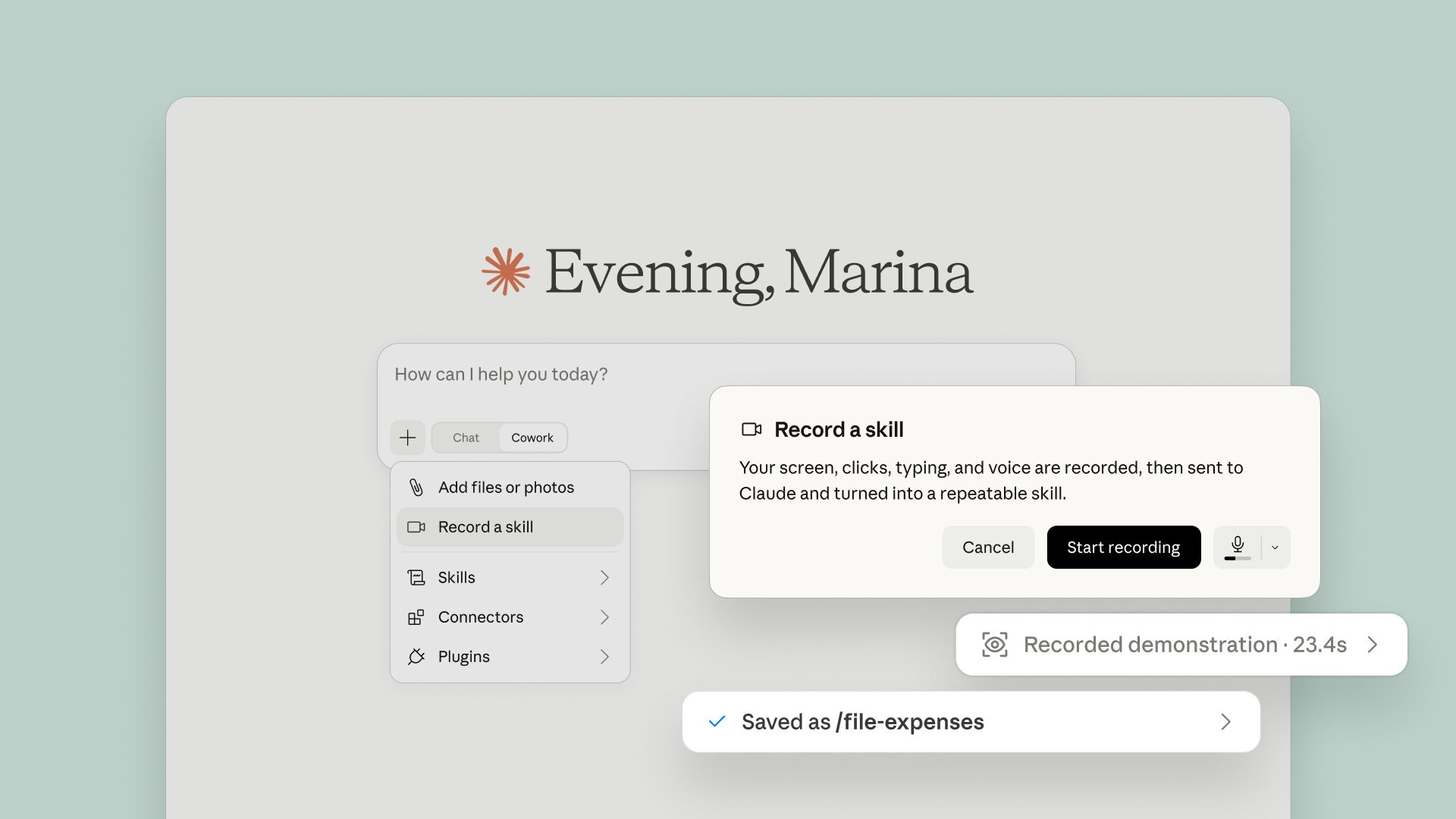
We’ve been telling marketers to write skills for months, and the pushback was always the same: it felt like a developer thing. Writing a skill file, even a simple one, was one abstraction too many for someone with a campaign to ship.
That excuse is gone.
If you can do the task and talk about it at the same time — and you already do this every time you onboard a junior — you can now automate it.
Start with the task you’d least like to explain to a new hire for the fourth time. The weekly reporting deck, the lead-list cleanup, or the way you reformat the agency’s deliverables before anyone else is allowed to see them. Record it once, narrate it like you’re training an intern, and see what comes out.
Worst case, you’ve documented your process. Best case, you never do it again.
Shopify Just Made Every Store Readable by AI Agents
Here’s a problem you may not have thought about: when an AI agent shops on someone’s behalf, it usually has to operate your website the way a confused tourist would. It “looks” at the page, guesses which button adds to cart, clicks, hopes. It is slow, error-prone, and expensive.
This week, with zero announcement, Shopify fixed that for millions of stores at once: every storefront it hosts now hands visiting agents a simple menu of things it can do. Search the catalog. Pull product details. Check the return policy. Add to cart. Start checkout. The agent picks from the menu instead of fumbling with the user interface. It’s already live on Reebok, Alo Yoga, Fenty Beauty, Steve Madden, and basically every standard Shopify store — including, probably, yours.
The technology behind this is called WebMCP, and it’s on track to become an official web standard, with Google’s Chrome and Microsoft’s Edge teams both pushing it. To be clear about what it doesn’t do: no agent can spend money on its own. The final purchase still requires the actual human to confirm. But think about what robots.txt did for search engines — a simple convention that told Google what it could look at, and within a few years everyone had one. This is shaping up to be that, except for agents that act instead of just read. When Shopify makes something the default across millions of stores, the rest of e-commerce tends to copy it within a quarter.
So what do you actually do? If you’re on a standard Shopify store, nothing — you already have it, and it might be worth asking your agency or dev team to show you what your store now offers agents.
If your storefront is custom-built and hosted by your own team, the switch wasn’t flipped for you; adding this is a real (small) project someone needs to own.
And if you’re not in e-commerce at all, file the question away, because it’s coming for your site too: when a customer’s agent shows up, does it get a menu, or does it get the confused-tourist treatment?