



We talk a lot about taste, refined judgment, preserving quality, and the impact of AI on creativity. Those are all important topics, and we still support them fully. But…
But this edition will be all about one thing: volume. To be precise: volume at scale.
To illustrate the volume, we just published 1,600+ pages on a single subdomain. Tool reviews and head-to-head comparisons. Prompts. Glossary terms. Q&A pages. Statistics. Strategy guides. Career resources. Templates and frameworks.
We published them within an hour. Without a single human being writing them.
The goal was simple:
Win programmatic SEO with volume at scale
Create a content hub that leads visitors to our core content
Drive signups, dominate search & AI citations
The content? Well, it’s not our best work. Some of them are just okay. But they might be the most important thing we did this quarter. We wouldn’t even call it content, because it isn’t content marketing. It is an infrastructure for search.
In this edition, we will explain:
Why did we do this? What’s the point and goal of volume?
What’s the right framework for approaching this, and how can you avoid AI slop?
How to do it at scale with AI without spending too much time or money on it?
So let’s jump right into it.
The strategy that built a $3M business (and nobody noticed)
So before we explain our own example, let us share an inspiration. Pieter Levels built Nomad List — a platform for digital nomads to find cities to work from. Most people assume he won because the digital nomad trend was hot. He was in the right place at the right time.
That’s part of the story.
The real story: Nomad List has 10s of thousands of indexed pages in Google. Every city page. Every filter combination. “Safe cities with fast internet in Europe.” “Affordable places in Southeast Asia with good weather.” Each filter selection generates a unique URL. Each URL gets indexed. Each indexed page captures a long-tail search query that someone, somewhere, is typing right now.
It’s all automated. Pieter didn’t write 24,000 articles. He built a data structure, created a template, and let the system generate pages from the data. Google ate it up. The traffic compounded. And Nomad List became the default destination, not because it was the best-written resource on digital nomadism, but because it was everywhere in search results for every conceivable question a digital nomad might ask.
He’s making around $3 million a year. Largely as a solo founder.
He’s not alone. Zapier has over 70,000 programmatic pages (every app integration combination gets its own landing page). They pull in 16 million organic visitors a month. TripAdvisor has 700 million+ indexed pages. Wise generates a page for every currency pair. Canva created 2.2 million template pages and ranks for over 500,000 keywords.
None of these companies won by writing better blog posts. They won by building systems that generate relevant pages at a scale no content team could match manually.
This strategy has a name: programmatic SEO. And for years, it was reserved for companies with engineering teams and large data sets.
Not anymore. With AI, a single person can do it in under an hour at a massive scale.
Why you should do it and what we actually did
We are not SEO experts. To be honest, SEO was pretty boring for us. The last thing we could say is that “we are good at programmatic SEO.” I (Peter) literally had to look the term up a couple of years ago, because I cared that much about SEO anyway.
Yet, here we are, talking about this. So, believe it, we don’t want to sell you on SEO.
But we do want to sell you on the idea that, with AI, you can 100x your brand’s search visibility, including AI citations.
Why? Because with AI:
You can do this volume at scale in a short period of time
No team, technical details, or any SEO experience are needed
It’s a low effort but high impact thing to do for your brand
But this only works if you use the right framework. Otherwise, you will just generate massive junk and slop for the internet. To be clear about this: even with the right framework, you won’t be generating award-winning content. Probably not something that you would show to your clients either. But the mindset shift is this: it’s not content. It’s infrastructure.
And with any infrastructure, you need a system first. With the right system, you can scale the infrastructure without limits.
Our example
Ok, so let’s be transparent. We’ve built a content hub. You can take a look at it here.
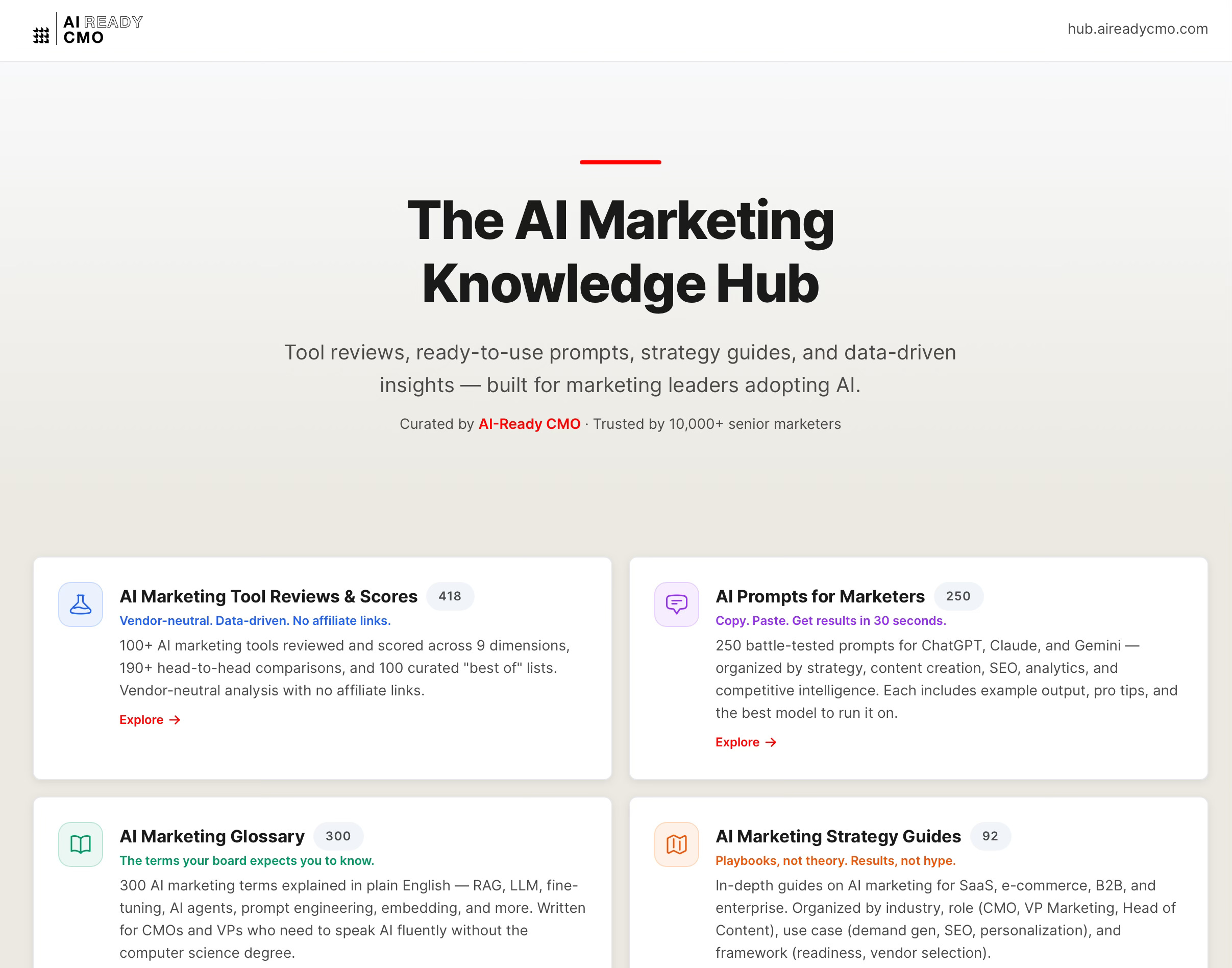
This hub won’t be linked from our homepage. Nor from any of our emails (except this one, as an example). But it keeps humming in the background, feeding the machine.
Here’s what’s on it:
410+ of AI marketing tool reviews and scores (100+ tools reviewed across 9 dimensions, 190+ head-to-head comparisons, 100 curated “best of” lists)
250 prompts for marketers (organized by strategy, content creation, SEO, analytics, and competitive intelligence)
300 AI marketing glossary terms explained in plain English
90+ strategy guides (organized by industry, role, use case, and framework)
50 stats with sourced data from McKinsey, Gartner, HubSpot, Salesforce, etc.
40+ templates and frameworks for AI marketing adoption
380+ Q&A pages answering the exact questions CMOs type into Google
70 careers and skills pages (job market data, role evolution, salary benchmarks)
That’s more than 1,600 unique, indexed pages.
Each one targets a specific long-tail search query. Each one is a potential entry point for a marketing leader who has never heard of us.
Every page has multiple points where we promote our newsletter with the last 5 articles (always fresh, based on RSS), and a signup box. It’s like an ad that interrupts the ad itself.
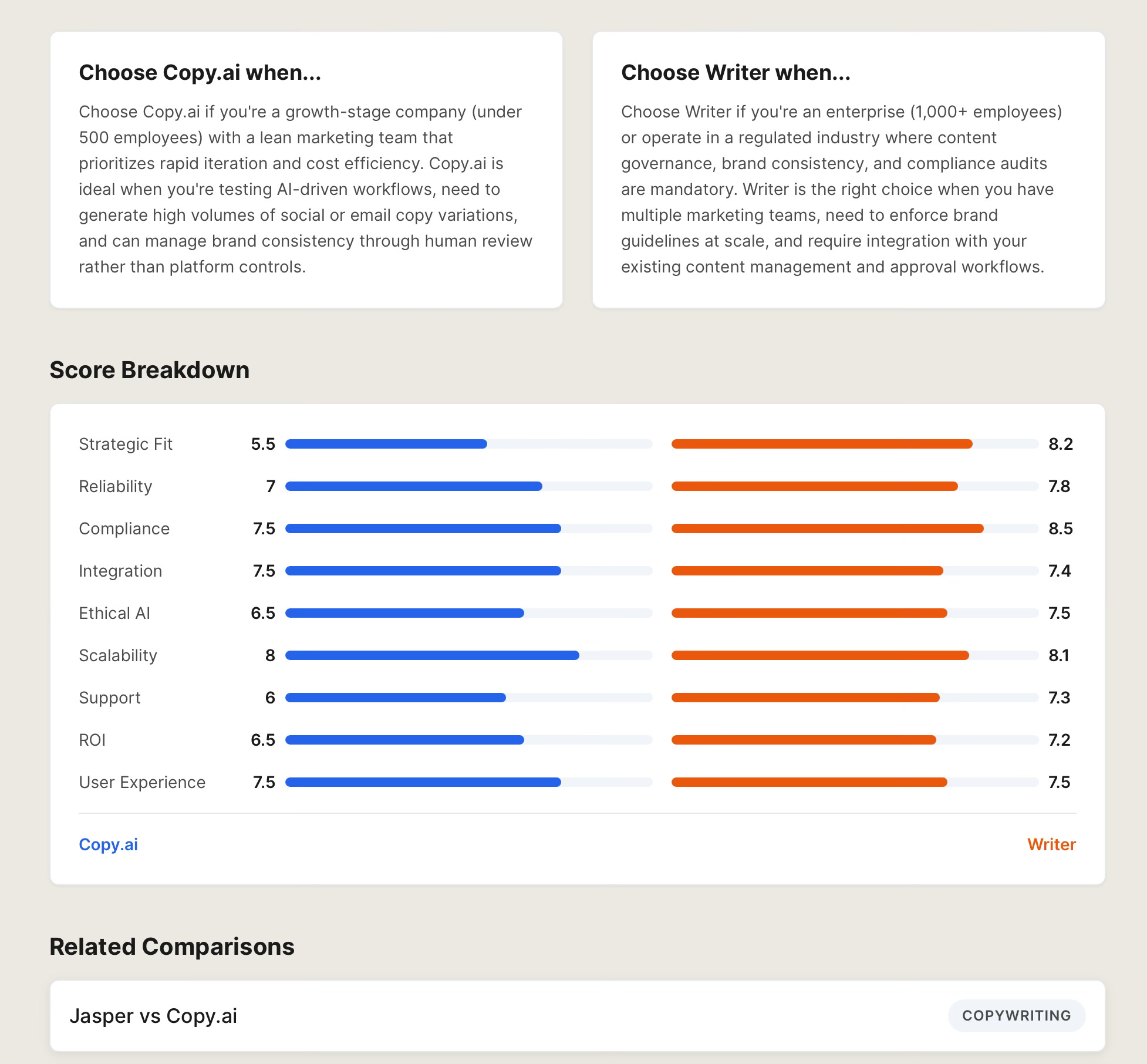
The hub is not our flagship content. Our daily newsletter is. Our weekend deep-dives are. The hub’s job is different: be there when someone searches “what is RAG in marketing,” “Jasper vs Copy.ai comparison,” or “how much does AI marketing cost.” Catch them. Then route them to the real stuff.
It took under an hour to generate. Anyone can do something like this for their brand with the right framework.
This framework is universal. It has 5 steps. Let us walk you through it using our example to illustrate.
The SCALE Framework for Programmatic SEO
This framework was born of our approach to this challenge. We’ve formalized our process into this. Five steps. Yep, you can put it on a slide.