
The Real Adobe MAX Story: Your AI, Not Theirs
The one thing you need to know in AI today | AI Ready CMO
Adobe announced roughly 100 new AI features at MAX this week, and I’m going to do you a favor: I’m not going to list them.
Instead, let’s talk about the two announcements that actually matter—not because they’re flashy, but because they represent a fundamental shift in how professional creative tools work.
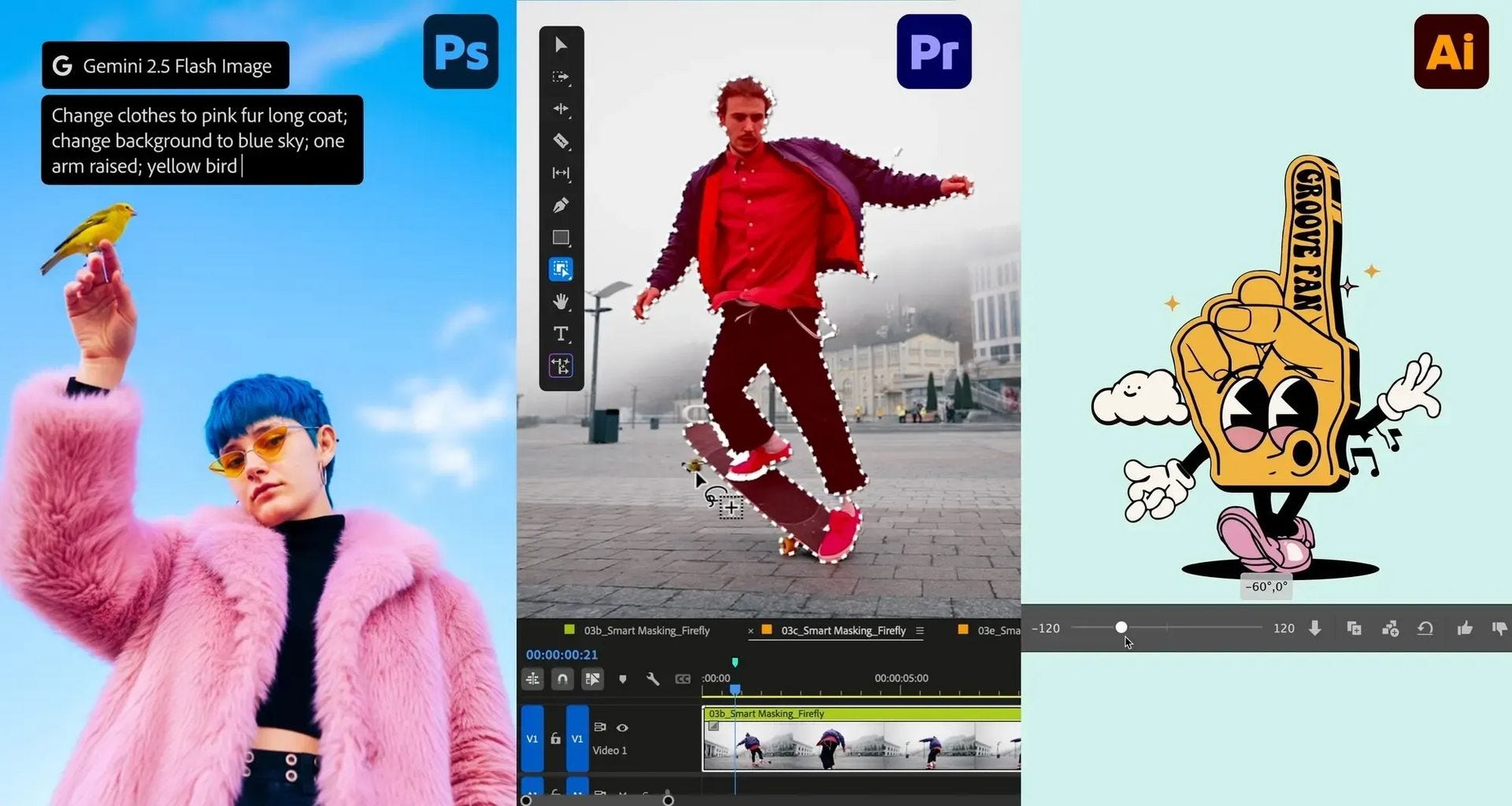
First: Adobe just opened the gates.
For years, Adobe’s business model was simple: you pay for Creative Cloud, you get Adobe’s tools. That’s over. Today, you pay for Creative Cloud, and you get access to Google’s Gemini and Veo, Runway’s video models, Topaz’s upscaling tech, ElevenLabs voice synthesis, Black Forest Labs’ FLUX models, and whatever else Adobe decides to integrate. Through December, it’s unlimited generations across all of them.
This is a model marketplace, not a model monopoly. Want Google’s Gemini for better scene coherence in Generative Fill? Use that. Need FLUX.1 for precision work? Switch to that. Prefer Runway for video generation? It’s right there in the same subscription.
Adobe is betting that professionals don’t want to manage seventeen different AI subscriptions, each with their own credit systems, APIs, and billing headaches. They want one subscription that gives them access to the best tool for each specific job.
It’s less “we make the best AI” and more “we give you the best AI control panel.”
The features this enables are legitimately useful. Photoshop’s new Generative Upscale uses Topaz tech to push low-res images to 4K. The new web-based Firefly video editor lets you mix Google’s Veo, Runway, and Pika on the same timeline. The AI Assistant in Photoshop can execute multi-step edits using whichever model makes sense for the task. Abstracting the model is a huge, welcome change.
But here’s what matters more: Firefly Custom Models.
Generic image generation is just a proof of concept, and most brand teams using AI face a consistency problem. You can make ten variations of a hero image, but they don’t quite feel like they belong to the same campaign.
That’s about to get fixed.
For the Coca-Colas and Nikes of the world, there’s Adobe’s AI Foundry, which we discussed last week. That’s where Adobe’s team trains proprietary models on your entire asset library, with the infrastructure to deploy them at scale. Coke gets an AI that only knows Coke’s visual DNA. Nike gets one that just does it.
The new Custom Models feature makes this available to anyone with Creative Cloud. Upload 10-30 of your product shots, illustration style examples, brand photography, and suddenly you ”train” an AI that generates output in your visual language.
Adobe is now offering both ends of the market—the self-service and concierge tiers.
With Custom Models, consistency becomes the default. You’re not teaching the AI about your brand in every prompt—the brand is the AI.
And because these custom models work across Adobe’s ecosystem—in Firefly, in Photoshop, in the new video editor, in GenStudio for enterprise campaigns—you’re not building isolated solutions. You’re building a coherent system.
The feature announcement was massive. The shift is bigger: from renting generic AI to training your own, with Adobe providing both the marketplace and the means of production.
3 AI Marketing Tools To Try Today
Gamma
Create polished presentations in minutes without design skills—Gamma AI generates slides, formats content, and suggests layouts automatically, turning outlines into professional decks instantly.
VidIQ
Grow your YouTube channel with AI-powered insights—VidIQ suggests trending topics, optimizes titles and tags, and analyzes competitor strategies to boost views.
CloudTalk
Transform customer calls into actionable intelligence—CloudTalk transcribes conversations, analyzes sentiment, and surfaces insights to improve sales and support.


