

AI Picks Favorites. Here's How to Be One.
The one thing you need to know in AI today | AI-Ready CMO


When someone asks an AI for a product recommendation, the model doesn’t test anything. It doesn’t open boxes, compare specs hands-on, or read every review on the internet. It gets a shortlist of already-relevant products from a search engine—typically around ten—and decides how to rank them based on the information attached to each one. A new research paper studied how that ranking decision works exactly.
Here’s the experiment. Researchers took real products across 15 Amazon categories, collected the top 10 search results for each, and fed those shortlists to four major LLMs. Then they tried to influence which product the AI would recommend first, using content changes only.
It worked, and the success rates are very encouraging. By appending well-crafted content to a product’s description—either structured reasoning explaining why the product is the best fit, or realistic review-style narratives—the researchers moved the #10 product to #1 around 80% of the time.
They also found that different models respond to different content styles. GPT and Claude favored logical, step-by-step reasoning. Gemini and Grok responded more to review-like narratives written as authentic purchase experiences. This preference even varied by category: reviews performed better in Beauty and Fashion, while reasoning won in Electronics and Tools.
Now, important caveats.
This was a controlled experiment. The researchers fed candidate lists directly to the models via API—the LLMs weren’t using their own search tools or browsing the web in real time, which is how most consumers actually interact with AI search. So we can’t say this translates one-to-one to what happens when someone asks ChatGPT or Gemini for a recommendation in the wild.
What we can say is that when an LLM is deciding between a set of comparable products, the structure and framing of the content attached to each product have a measurable influence on the outcome.
The other finding worth paying attention to: the review-style content was nearly indistinguishable from the real thing. Human evaluators flagged it as manipulated only 18% of the time, scoring it 4.6 out of 5 on fluency—almost identical to genuine product descriptions.
The researchers tested three different defenses against this kind of manipulation and concluded that none of them were sufficient. That’s a trust problem that AI search platforms will need to solve, and soon.
The practical takeaway is straightforward.
If your products are already competitive—and if you’re reading this, they probably are—the content surrounding them matters in ways it didn’t before. Not keyword density. Not link building. The actual substance of how you explain what your product does, who it’s for, and why it’s the right choice.
Structured reasoning, clear comparisons, genuine use cases.
That’s what these models respond to when they’re deciding who gets recommended first in a list of equals.
— Torsten and Peter
3 AI Marketing Tools To Try Today
Rankprompt
RankPrompt tests how your brand appears across AI assistants like ChatGPT and Gemini, benchmarking visibility against competitors. A must-explore for anyone serious about understanding how AI search engines recommend (or ignore) their brand.
AI SEO
AI writing and SEO tool that generates articles, rewrites content to sound human, and optimizes copy for search engines with readability scoring. Handy for marketers who want a lightweight all-in-one writing assistant without the enterprise price tag.
Metricool
Cross-platform social media analytics and scheduling hub that centralizes performance data from every major channel into one dashboard with competitor benchmarking built in. Fills the gap between basic scheduling tools and enterprise suites like Sprout Social — ideal for data-driven social teams who need reporting depth without the $300/month price tag.
Stop Buying AI Tools on Hype. Start Buying on Data.
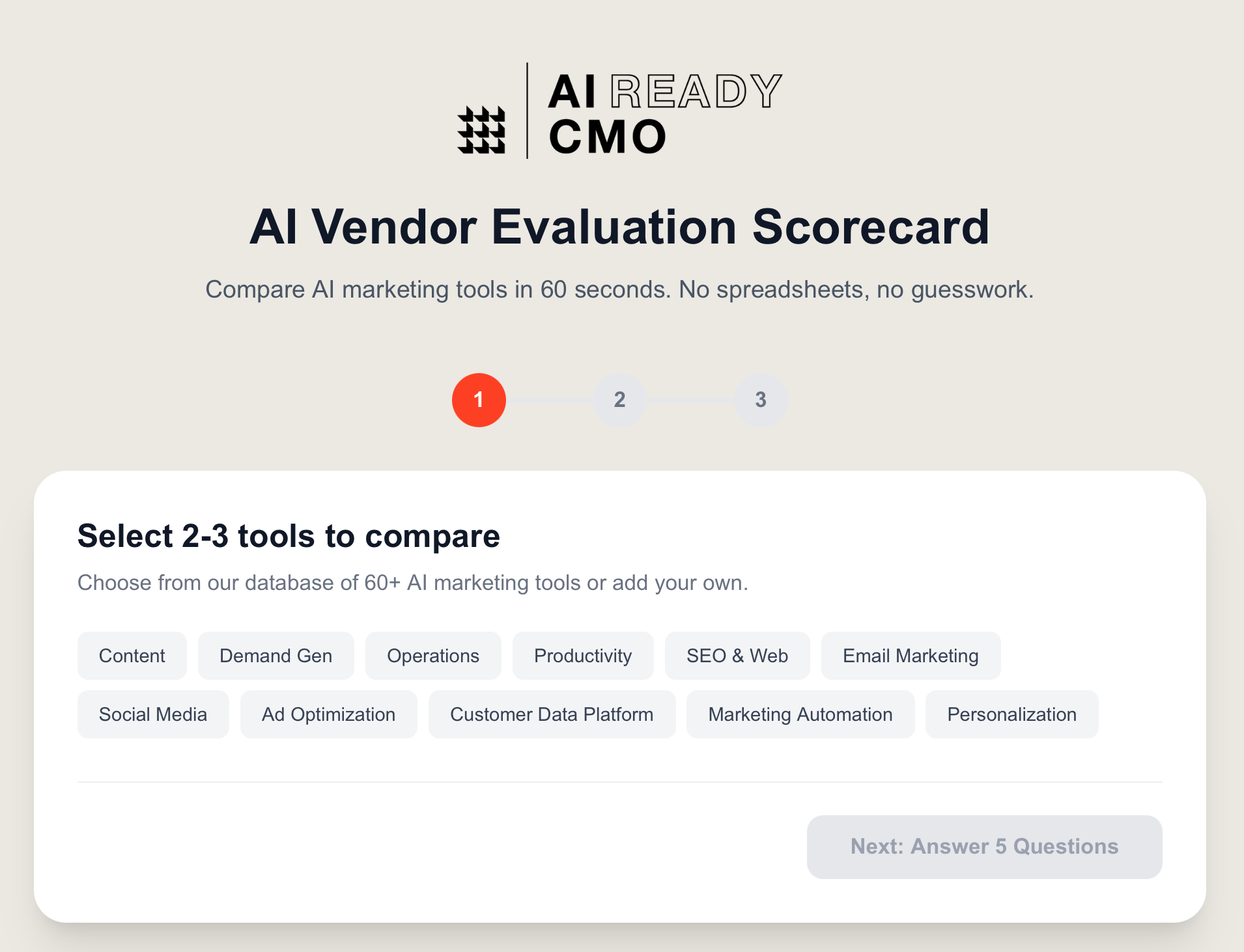
Compare AI marketing vendors side-by-side. Get objective scores based on features, pricing, integrations, and user reviews. Make vendor decisions your CFO will actually approve.
The AI Vendor Scorecard compares multiple AI tools based on your team size and needs. Start with 60+ tools already in our database or add your own. Let AI research capabilities, extract pricing tiers, map integrations, and score each vendor across the criteria that matter to your organization.
Stop trial-and-error procurement. Start data-backed decisions.
Available for AI-Ready CMO paid subscribers.